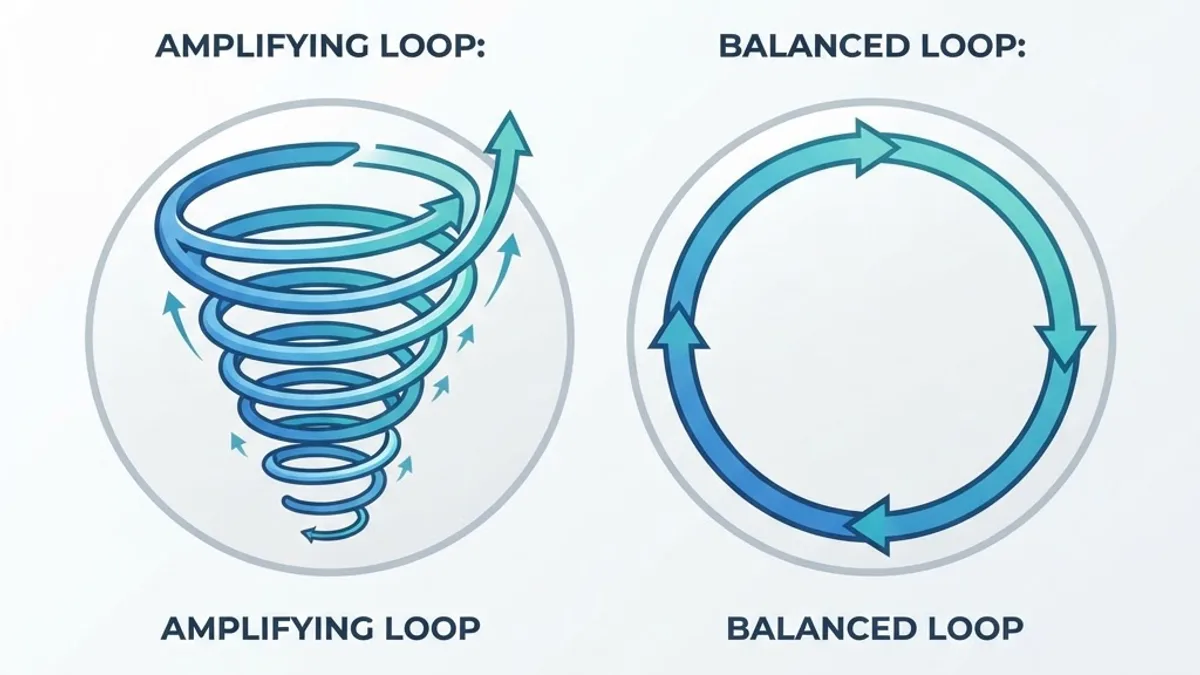
The difference between positive and negative feedback: one amplifies change while the other counteracts it. Clear examples from biology, engineering, and work.
Introduction
The difference between positive feedback and negative feedback comes down to one word: direction. Positive feedback amplifies a change, pushing a system further away from where it started. Negative feedback counteracts a change, pulling the system back toward a stable set point. Neither term means "good" or "bad" — they describe how a loop responds, not whether the outcome is desirable.
This distinction shows up everywhere: in the human body keeping your temperature steady, in a thermostat regulating a room, in an amplifier circuit, and even in how a manager's comments shape an employee's behaviour. Understanding it helps you predict whether a system will stabilise or spiral. This guide breaks down both types with plain definitions, side-by-side comparisons, and concrete examples.
Table of Contents
- Quick Definitions
- The Core Difference at a Glance
- How Negative Feedback Works
- How Positive Feedback Works
- Positive vs. Negative Feedback in Biology
- Feedback in Engineering and Technology
- Feedback in the Workplace
- Common Misconceptions
- Frequently Asked Questions
- Conclusion
Quick Definitions
- Negative feedback is a self-correcting loop. When output deviates from a target, the system responds in the opposite direction to reduce that deviation. The result is stability and equilibrium.
- Positive feedback is a self-reinforcing loop. When output moves in a direction, the system responds by pushing it further the same way. The result is amplification, acceleration, or a runaway effect.
The Core Difference at a Glance
| Aspect | Negative Feedback | Positive Feedback |
|---|---|---|
| Effect on change | Opposes and reduces it | Reinforces and amplifies it |
| Outcome | Stability, equilibrium | Escalation, rapid change |
| Direction | Back toward set point | Away from set point |
| Common result | Balance maintained | Loop runs until an external limit stops it |
| Everyday example | Thermostat | Microphone-speaker squeal |
| Biology example | Body temperature control | Blood clotting, childbirth |
How Negative Feedback Works
Negative feedback is the mechanism of balance. A system monitors its own output, compares it to a desired set point, and acts to cancel any difference.
Think of a thermostat. You set it to 21°C. If the room heats up, the thermostat turns the heater off; if it cools down, it turns the heater on. The response always opposes the change, so the temperature oscillates gently around the target and never runs away. This is why negative feedback is the foundation of homeostasis in living things and of stability in most engineered control systems.
Key characteristics:
- It reduces the effect of disturbances.
- It keeps variables within a healthy or desired range.
- It tends toward a stable equilibrium.
How Positive Feedback Works
Positive feedback is the mechanism of amplification. Instead of cancelling a change, the system responds by increasing it, so the next round is even bigger.
The classic demonstration is audio feedback: a microphone picks up sound from a speaker, the amplifier boosts it, the speaker plays it louder, the mic picks it up again, and within a second you get a screeching tone. There is no set point pulling the system back — only escalation until an external limit (or someone turning down the volume) stops it. If you want a deeper look at loops that never resolve, see our explainer on what an infinite feedback loop is called.
Key characteristics:
- It magnifies small changes into large ones.
- It drives rapid, sometimes explosive, change.
- It requires an external limit to stop, because it has no internal brake.
Positive vs. Negative Feedback in Biology
Biology is the easiest place to see both loops at work.
Negative feedback in the body
- Body temperature: sweating cools you when you overheat; shivering warms you when you are cold.
- Blood sugar: insulin lowers high glucose, glucagon raises low glucose.
- Blood pressure: baroreceptors adjust heart rate and vessel width to hold pressure steady.
These loops keep internal conditions within the narrow ranges cells need to survive — the essence of homeostasis.
Positive feedback in the body
- Childbirth: contractions push the baby against the cervix, releasing oxytocin, which triggers stronger contractions — escalating until birth.
- Blood clotting: activated platelets release chemicals that activate more platelets, rapidly sealing a wound.
- Nerve impulses: the rising phase of an action potential is a fast positive loop of sodium influx.
Notice that these positive loops are useful precisely because they have a clear natural endpoint — the baby is born, the wound is sealed. That built-in stop is what keeps them from being destructive.
Feedback in Engineering and Technology
Engineers use both deliberately.
- Negative feedback stabilises amplifiers, keeps cruise control at a set speed, and regulates voltage. It trades a bit of gain for a lot of reliability.
- Positive feedback is used where you want a decisive switch — in oscillators, comparators, and flip-flop memory circuits that snap firmly between states.
In software, the same logic applies. A well-built application uses corrective (negative) logic to keep state consistent, while an accidental self-reinforcing loop can freeze an interface. Teams doing serious front-end web development design their data flow specifically to avoid runaway update loops. And when explaining these dynamics to clients or students, a clean infographic design makes the amplify-versus-correct contrast instantly obvious.
Feedback in the Workplace
The words "positive" and "negative" feedback also describe communication at work — and here the everyday meaning overlaps with the technical one in an interesting way.
- Positive feedback (praise) reinforces a behaviour, encouraging someone to do more of it — genuinely a self-reinforcing loop.
- Negative feedback (constructive criticism) aims to reduce or correct a behaviour, steering someone back toward a standard — a self-correcting loop.
The healthiest teams blend both, using praise to amplify strengths and constructive input to correct course. If you are refining how your organisation delivers input to people, our guides on giving 360 feedback to your boss and improving employee satisfaction with the feedback process apply these ideas to real conversations.
Common Misconceptions
- "Positive feedback is always good." Not true. Positive means amplifying; it can amplify harm just as easily as benefit (think of a bank run or runaway climate warming).
- "Negative feedback is bad." Also false. Negative feedback is the hero of stability, keeping bodies and machines safe.
- "Positive loops last forever." Only if nothing limits them. Most are stopped by physical constraints or a counteracting negative loop.
Frequently Asked Questions
What is the main difference between positive and negative feedback?
Positive feedback amplifies a change and pushes a system away from its starting point, while negative feedback counteracts a change and returns the system toward a stable set point.
Does "positive" feedback mean it is beneficial?
No. In systems terms, "positive" means self-amplifying and "negative" means self-correcting. The labels describe direction, not desirability.
What is an example of negative feedback in the body?
Temperature regulation — sweating to cool down and shivering to warm up — keeps your core temperature stable through negative feedback.
What is an example of positive feedback in the body?
Childbirth, where contractions stimulate the release of oxytocin, which strengthens contractions until delivery.
Why is negative feedback more common in nature?
Because survival depends on stability. Homeostatic (negative) loops keep temperature, pH, and blood sugar within safe ranges.
Can a system use both types of feedback?
Yes. Many systems combine positive feedback for rapid response with negative feedback to prevent it from running away.
Is workplace praise a positive feedback loop?
Yes, in the systems sense — praise reinforces a behaviour and encourages more of it, which is self-amplifying.
Conclusion
The difference between positive and negative feedback is direction: positive feedback amplifies change and drives escalation, while negative feedback counteracts change and produces stability. From body temperature to thermostats, from childbirth to audio squeals, and from software state to workplace conversations, the same two patterns explain why some systems settle and others spiral. Once you can spot which loop is running, you can predict — and control — what a system will do next.
If you are building tools, dashboards, or educational content that needs to make complex systems easy to understand, Faidaa can help. Get in touch to turn abstract concepts into clear, engaging digital experiences.