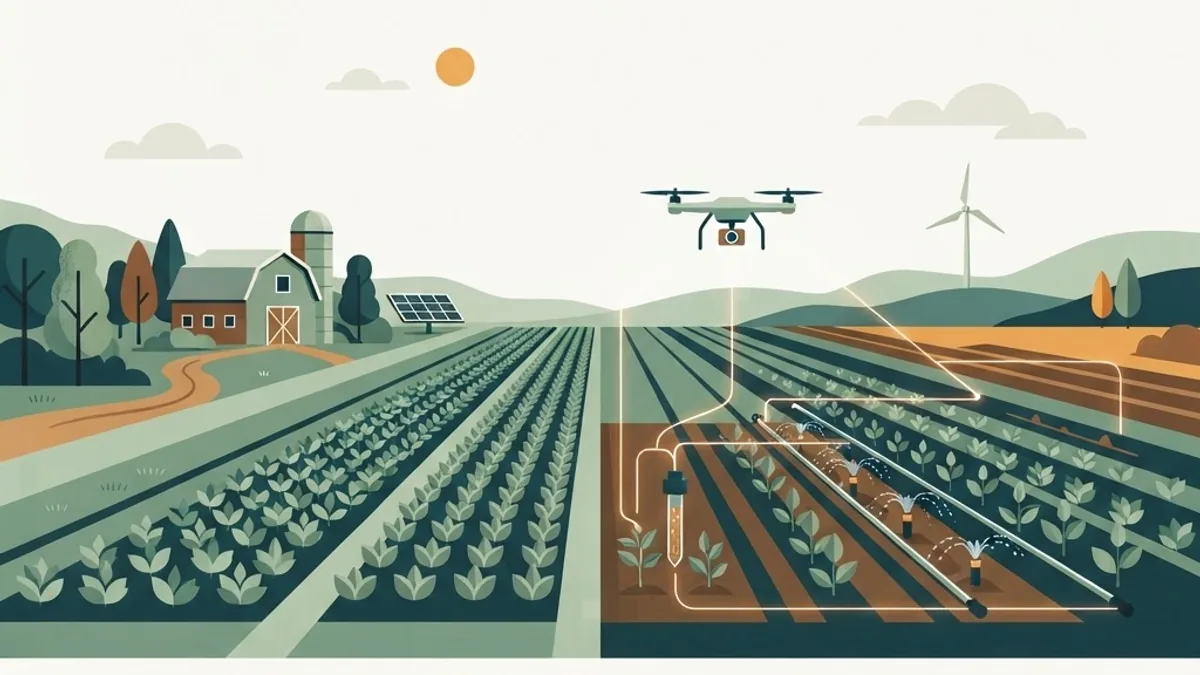
A practical, step-by-step guide to adding technology to traditional farming without abandoning proven methods, sized for smallholders and family farms.
Introduction
The usual framing of agricultural technology pits tradition against modernity: either you farm the way your family always has, or you buy a satellite-guided tractor. In practice, the farms that adapt best do neither. They keep the accumulated local knowledge that generations built — which field drains poorly in a wet spring, which variety survives a late frost, which intercropping pattern suppresses a specific pest — and they add tools that measure what human observation cannot.
That combination is where the real gains are. Traditional knowledge is dense, place-specific, and hard-won, but it cannot tell you the nitrogen level in a particular corner of a field or the moisture at root depth on a cloudy morning. Technology measures precisely but knows nothing about your land. Put together, they consistently outperform either approach alone.
This guide explains how to integrate technology with traditional farming in a realistic sequence, starting with tools that cost almost nothing and scaling only when each step has paid for itself. It is written for smallholders, family farms, and mid-sized operations rather than industrial agribusiness.
Table of Contents
- Why integration beats replacement
- The core principle: measure before you spend
- Step 1: Document what you already know
- Step 2: Soil testing as the foundation
- Step 3: Weather data and climate services
- Step 4: Water management and smart irrigation
- Step 5: Recordkeeping and farm management software
- Step 6: Sensors, monitoring, and simple automation
- Step 7: Drones and remote sensing
- Step 8: Mechanization matched to your scale
- Step 9: Livestock technology
- Step 10: Market access and direct selling
- Step 11: Post-harvest storage and cold chain
- Financing, cooperatives, and shared equipment
- Common mistakes that waste money
- Frequently Asked Questions
- Conclusion
Why integration beats replacement
Farming has been described as the world's oldest continuously refined technology, and traditional systems encode solutions that modern agriculture rediscovered late.
Crop rotation maintains soil structure and interrupts pest cycles. Intercropping and polyculture reduce disease pressure and spread weather risk across species. Locally adapted seed varieties carry resistance traits developed over decades of selection in your specific microclimate. Composting and manure integration build organic matter that no synthetic input replicates. Terracing and contour planting control erosion on slopes where machinery-oriented layouts fail.
Modern precision agriculture, meanwhile, contributes something traditional practice cannot: measurement at a resolution and frequency human senses cannot achieve. It tells you the specific nutrient deficiency rather than "the crop looks tired," soil moisture at 30 centimeters rather than the feel of the topsoil, and a disease signature days before symptoms are visible.
The correct mental model is therefore not replacement but instrumentation. You are adding sensors and records to a system that already works, so you can see it more clearly.
The core principle: measure before you spend
Almost every failed technology adoption on a small farm shares the same cause: buying equipment before identifying the actual limiting factor.
Every farm has one constraint that caps yield more than any other — water, a specific nutrient, soil pH, pest pressure, labor at a critical window, or market access. Investment in anything other than that constraint produces disappointing returns, which is why so many farmers conclude "technology doesn't work here" after an expensive false start.
So before spending, answer three questions with evidence rather than intuition:
- What is limiting my yield right now? Soil tests, field records, and yield differences between plots will tell you.
- What is my largest avoidable cost? Often water, fertilizer applied where it is not needed, fuel, or post-harvest losses.
- Where do I lose the most product? Frequently storage and handling rather than the field itself.
Then buy the cheapest tool that addresses the biggest of those three.
Step 1: Document what you already know
This step costs nothing and delivers more than most purchases.
Traditional farming knowledge usually lives in memory and gets lost between generations. Writing it down converts it into a dataset you can actually reason about.
Record, field by field:
- Planting and harvest dates for the past several seasons, with variety names.
- Yields per plot, even as rough estimates.
- Which areas flood, dry out first, or produce poorly, and your theory about why.
- Pest and disease appearances with dates and weather conditions at the time.
- Input applications with quantity, timing, and cost.
- Labor hours by task, which almost nobody tracks and which frequently reveals the real bottleneck.
A paper notebook is genuinely fine to start. The point is that three seasons of honest records let you see patterns invisible in a single year, and they make every later technology decision better informed.
Step 2: Soil testing as the foundation
If you do only one technical thing, do this.
Soil testing measures pH, organic matter, nitrogen, phosphorus, potassium, micronutrients, and often texture and cation exchange capacity. It costs a modest amount per sample and routinely changes fertilizer decisions enough to pay for itself in a single season.
The most common findings on farms that have never tested are worth knowing in advance. Many farms are applying nutrients that are already sufficient while ignoring the one that is actually limiting. Many have pH problems that block nutrient uptake entirely, meaning fertilizer is being wasted regardless of quantity — a lime application often outperforms any fertilizer purchase. And nutrient levels frequently vary substantially between fields that look identical.
Practical method: sample separately for each distinct area — different soil type, slope, or cropping history. Take 10 to 15 cores per zone at consistent depth, mix them, and submit the composite. Retest every two to three years, always at the same time of year for comparability.
Where technology extends this: portable pH and electrical conductivity meters give instant field readings for spot checks between lab tests, and grid or zone sampling combined with a simple field map lets you apply inputs by area rather than uniformly across a whole holding.
Step 3: Weather data and climate services
Traditional weather reading — cloud patterns, wind shifts, animal behavior, seasonal indicators — remains genuinely useful and often locally accurate. Technology extends its range rather than replacing its judgment.
Free or low-cost tools: national meteorological forecasts, agricultural extension advisories, SMS-based weather alerts available in many regions, and growing degree day trackers that predict crop development and pest emergence more reliably than calendar dates.
Worth buying when justified: an on-farm weather station measuring rainfall, temperature, humidity, wind, and leaf wetness. Local readings often differ substantially from the nearest official station, and leaf wetness duration in particular drives fungal disease risk models that can cut spray applications significantly.
How to use it well: delay a nitrogen application before heavy rain to avoid leaching losses, time spraying to avoid wind drift and wash-off, schedule harvest around a dry window, and use frost warnings to trigger protective measures. Each of these is a decision traditional practice already makes — the data simply improves the odds.
Step 4: Water management and smart irrigation
Water is the limiting factor on a majority of farms worldwide, and irrigation is where technology delivers its most reliable returns.
Start with efficiency, not electronics. Drip irrigation delivers water directly to root zones and typically cuts water use by 30 to 50 percent compared with flood or furrow methods while improving yields, because it maintains consistent moisture rather than cycling between saturation and drought. Mulching — a traditional practice — reduces evaporation dramatically and pairs perfectly with drip lines.
Then add measurement. Soil moisture sensors placed at root depth end the guesswork behind irrigation timing. Farmers who install them frequently discover they were both overwatering during cool periods and underwatering during heat waves, sometimes in the same month.
Then automate. Timer or sensor-controlled valves irrigate based on actual soil moisture rather than a fixed schedule. Solar-powered pumps eliminate fuel costs and are transformative where grid power is unreliable.
Also worth doing: rainwater harvesting, which is ancient technology, combined with modern storage and simple filtration. And in dry regions, deficit irrigation strategies — deliberately mild water stress at growth stages where it does not reduce yield — can save substantial water with sensor data to guide it.
Step 5: Recordkeeping and farm management software
Once you have a season or two of paper records, moving them into software makes patterns visible and reporting far easier.
Farm management systems handle field mapping and plot histories, input tracking with cost per field, labor scheduling, harvest and yield logging, profitability analysis by crop and by plot, and compliance documentation for organic or export certification.
The revelation most farms experience here is unglamorous but important: profitability calculated per plot rather than for the whole farm often shows that one or two crops or fields are losing money and being subsidized by the rest. That insight alone can restructure a farm's planning.
Selection advice: choose software that works offline and syncs later, since rural connectivity is unreliable. Prefer tools that export your data in standard formats so you are never trapped. Start with the free tier of anything before paying. And if your operation has genuinely unusual requirements — a cooperative managing many members, or a mixed enterprise with processing — a purpose-built system through web applications development may be more practical than forcing a generic product to fit.
Step 6: Sensors, monitoring, and simple automation
Beyond irrigation, targeted sensors solve specific recurring problems.
- Greenhouse and tunnel controls for temperature, humidity, and ventilation, which prevent the crop losses that come from a single unmonitored hot afternoon.
- Grain storage monitoring for temperature and moisture, catching spoilage and insect activity before it spreads through a silo.
- Cold storage alarms that alert you when a refrigeration unit fails at night — often the highest value alarm on a farm.
- Water tank and trough level sensors, which prevent livestock water interruptions.
- Electric fence monitoring that reports faults instead of leaving you to discover them when animals escape.
- Pest traps with automated counting that flag population thresholds so spraying is triggered by evidence rather than calendar.
Prioritize by consequence of failure. A sensor that prevents one destroyed batch of stored produce pays for a great deal of equipment.
Step 7: Drones and remote sensing
Aerial imagery is now accessible to farms far smaller than it once was, and it answers a question ground inspection struggles with: how does the whole field compare with itself?
Practical uses: vegetation index mapping that reveals stress zones before symptoms are visible at ground level, identifying drainage and compaction problems from patterns invisible on foot, measuring plant stand and gaps after emergence, monitoring irrigation coverage, documenting damage for insurance claims, and targeting scouting effort at the areas that actually need attention.
Free alternative: publicly available satellite imagery from programs like Sentinel and Landsat provides regular vegetation index data at no cost, sufficient for many field-scale decisions.
Realistic caution: drone imagery generates data, not decisions. Interpreting it correctly takes learning, and regulations on flight and licensing vary by country. For many farms, hiring a drone service a few times per season beats buying and maintaining equipment.
Step 8: Mechanization matched to your scale
Full-size machinery is usually the wrong purchase for a small farm. Appropriately scaled mechanization is often transformative.
Two-wheel tractors and power tillers, small seeders and transplanters, mechanical weeders, threshers, and irrigation pumps often address the real bottleneck — labor concentrated in narrow time windows — at a fraction of the cost of large equipment.
Where advanced technology genuinely helps larger operations: GPS guidance that eliminates overlap and gaps, variable rate application that matches inputs to soil test zones, and yield monitors that build spatial performance maps over time.
The decision rule: mechanize the task where a timing delay costs you the most yield. On many farms that is weeding, not ploughing, because weed competition during early growth causes losses that cannot be recovered later.
Step 9: Livestock technology
Mixed farms often see faster returns from livestock technology than from crop technology.
Electronic identification and simple herd records track individual animal performance, breeding dates, treatments, and withdrawal periods. Automated watering ensures constant supply. Rumination and activity monitors detect illness and heat cycles earlier than visual observation, which improves both conception rates and treatment outcomes. Automated feeders improve consistency and reduce waste. Rotational grazing planning tools support a traditional practice with better timing data.
The economics are usually clear because individual animals are valuable, so preventing a single loss or improving conception rates measurably changes annual income.
Step 10: Market access and direct selling
For many small farms, the binding constraint is not production at all. It is price. Selling into a local market at whatever the intermediary offers caps income regardless of how well the crop grows.
Technology addresses this directly:
- Price information services that report market rates across regions, so you know whether an offer is fair.
- Direct sales channels — an online store, subscription vegetable boxes, or preorder systems — which capture the margin normally taken by intermediaries. A straightforward ecommerce solution can double the effective price a farm receives for the same produce.
- A basic farm website establishing credibility for buyers, restaurants, and certification bodies. Even a simple presence built through WordPress development is enough to be findable and contactable.
- Social media for demonstrating provenance and practices, which is exactly what premium buyers pay for. Consistent social media management turns transparency into a price advantage.
- Digital payments to reduce cash handling risk and create records that support loan applications.
- Traceability records required for export and premium contracts, which are far easier to maintain digitally.
This is the step most technology guides underweight, and it frequently has the highest return of anything on this list.
Step 11: Post-harvest storage and cold chain
Post-harvest losses are enormous in many regions — commonly 20 to 40 percent for perishables — and reducing them is equivalent to increasing yield without using another drop of water.
Practical interventions include hermetic storage bags that control insects without chemicals, evaporative cooling structures that need no electricity, solar dryers that produce better and safer dried product than open-air drying, solar-powered cold rooms, and simple moisture meters that tell you when grain is genuinely safe to store rather than probably safe.
The comparison worth internalizing: cutting storage losses from 30 percent to 10 percent delivers the same income effect as a 29 percent yield increase, usually at a fraction of the cost and risk.
Financing, cooperatives, and shared equipment
Cost is the real barrier, and there are established ways around it.
Cooperative purchasing spreads equipment cost across members, which is how most smallholder mechanization actually happens. Equipment sharing and rental covers seasonal machinery that would sit idle most of the year. Government and extension programs frequently subsidize irrigation, storage, and soil testing. Agricultural development loans may be available with a documented business case, which is precisely what your records from Step 1 provide. Phased adoption funded from realized savings is slower but avoids debt risk entirely.
A disciplined approach: never finance a technology purchase that cannot show a plausible payback within two to three seasons, and always test on a portion of your land first.
Common mistakes that waste money
- Buying equipment before identifying the limiting factor. The single most expensive error.
- Abandoning traditional practices wholesale. Crop rotation, composting, and local varieties are frequently outperforming their replacements.
- Ignoring maintenance and spare parts availability. Equipment that cannot be repaired locally becomes scrap.
- Adopting on the whole farm at once. Always trial on a section, compare against your normal practice, and expand only on evidence.
- Collecting data nobody reviews. Sensors that generate unread readings are decoration.
- Neglecting training. Budget time to learn the tool properly, or it will be used at a fraction of its capability.
- Chasing yield while ignoring margin. Higher yield at higher input cost can leave you worse off.
Frequently Asked Questions
What is the cheapest way to start integrating technology into traditional farming?
Systematic recordkeeping, which costs nothing but a notebook, followed by soil testing, which is inexpensive and routinely changes fertilizer spending enough to pay for itself immediately. Both improve every subsequent decision.
Will modern technology destroy traditional farming knowledge?
Only if it is adopted as a replacement rather than an addition. The most productive approach documents traditional knowledge and uses measurement to verify and refine it. Local varieties, rotation systems, and soil-building practices frequently outperform modern alternatives and should be tested rather than discarded.
Does precision agriculture work on small farms?
Yes, though not in the form marketed to industrial operations. On small plots the useful tools are soil testing by zone, moisture sensors, drip irrigation, weather data, and record analysis — not GPS-guided machinery, which needs scale to justify itself.
How much yield improvement can I realistically expect?
Soil testing with corrected fertilization commonly delivers 10 to 25 percent where a nutrient or pH problem existed. Efficient irrigation with moisture monitoring often yields similar gains while cutting water use substantially. Reducing post-harvest losses frequently produces the largest income effect of all. Claims of dramatic transformation from a single device deserve skepticism.
What if I have no reliable internet access?
Choose tools that function offline. Soil tests, sensors with local displays, mechanical equipment, storage improvements, and SMS-based weather and price services all work without broadband. Farm management software should sync when a connection is available rather than requiring one continuously.
Should I get certified organic if I already farm traditionally?
Often yes, because many traditional practices already meet or nearly meet organic standards, and certification captures a price premium. The main work is documentation, which is exactly what digital recordkeeping makes manageable.
Which single technology gives the best return for most small farms?
Irrigation efficiency combined with soil moisture monitoring, in water-limited areas. Where water is abundant, improved storage and market access usually deliver more, because the losses and lost margin there are larger than most farmers estimate.
How do I convince older family members to try new tools?
Trial a single change on a small area and compare results side by side against the usual method, in the same season. Evidence from their own land is far more persuasive than any argument, and it also protects the farm if the new approach underperforms.
Conclusion
Integrating technology with traditional farming works best when it is understood as adding instruments to a system that already contains a great deal of intelligence. The generational knowledge on a farm — which soil behaves how, which variety survives which season, which practice keeps a pest in check — is data collected over decades. Sensors, soil tests, weather models, and imagery simply extend that record into the places human observation cannot reach.
The sequence that consistently works is unglamorous: write down what you know, test your soil, fix water efficiency, keep proper records, add sensors where failure is costly, improve storage, and get direct market access. Each step funds the next. Skipping to expensive equipment before identifying your actual constraint is the reliable way to conclude that technology does not work on your farm.
Ready to turn your harvest into a stronger business? Reach customers directly with a proper ecommerce solution, a farm site built through professional website design, and email marketing that keeps buyers coming back season after season.