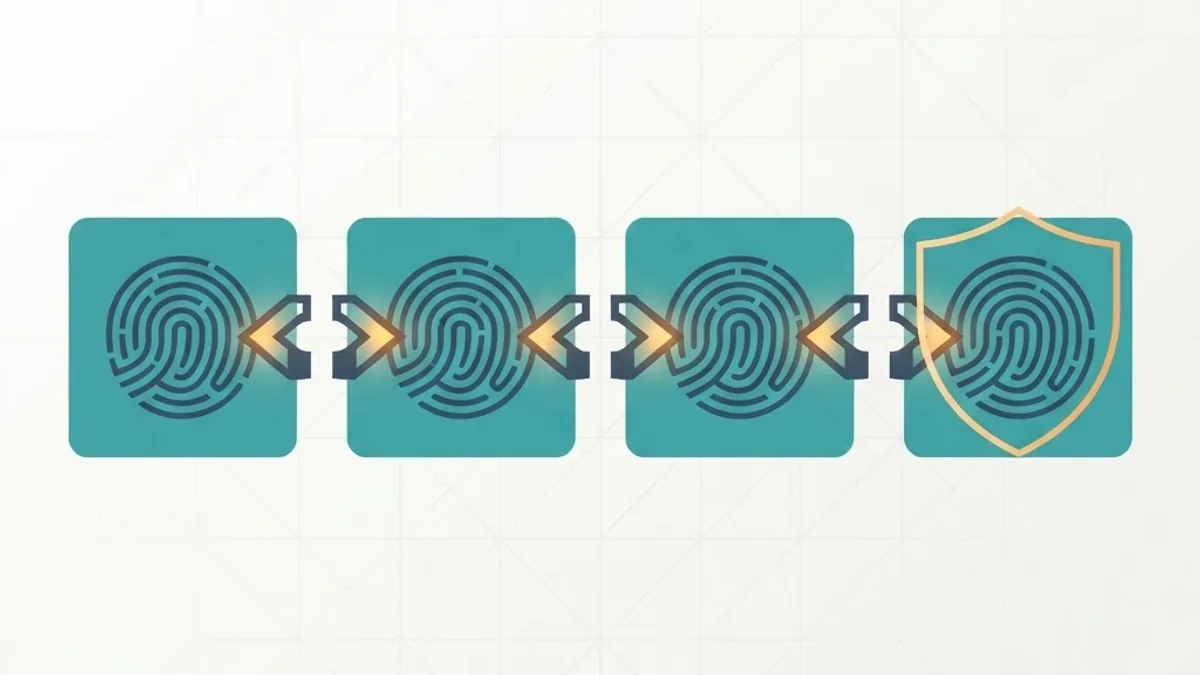
A clear explanation of how cryptographic hashing secures blockchains, covering hash properties, block linking, Merkle trees, mining, and real attack limits.
Introduction
Strip away the jargon and a blockchain is a shared record that thousands of strangers maintain without trusting one another. That arrangement should not work. Any of those participants could rewrite history in their favor, insert a fake transaction, or quietly delete an inconvenient one. The reason it works anyway comes down largely to one deceptively simple mathematical tool: the cryptographic hash function.
Hashing is the mechanism that makes blockchain data tamper-evident. It does not encrypt anything, it does not hide information, and it does not stop someone from trying to alter a record. What it does is make any alteration immediately and unmistakably detectable to everyone — and that is enough to secure a system with no central authority.
This article explains exactly how a hash helps secure blockchain technology: what a hash function is, the specific properties that make it useful, how blocks are chained together, how Merkle trees allow efficient verification, how hashing powers proof of work, and where the genuine limits and vulnerabilities lie.
Table of Contents
- What a hash function actually is
- The five properties that make hashing secure
- How hashes link blocks into a chain
- Why changing one old record breaks everything after it
- Merkle trees and efficient verification
- Hashing in proof of work mining
- Hashes and digital signatures for ownership
- Hash pointers and content addressing
- What hashing does not protect against
- Real attacks and hash function lifespans
- Quantum computing and hashing
- Practical examples of hash-based verification
- Frequently Asked Questions
- Conclusion
What a hash function actually is
A cryptographic hash function takes input of any size and produces a fixed-length output — a string of characters that acts as a digital fingerprint of that data.
Bitcoin uses SHA-256, which always produces a 256-bit output, typically written as 64 hexadecimal characters. Feed it a single letter and you get 64 characters. Feed it an entire library and you get 64 characters. The output length never changes.
Three things about this are worth grasping immediately.
The output is deterministic. The same input always produces exactly the same hash, on any machine, in any year. This is what makes independent verification possible.
The output looks random but is not. It is fully determined by the input, yet has no visible relationship to it. You cannot look at a hash and infer anything about the data that produced it.
Tiny input changes produce completely different outputs. Change one character, one comma, or one bit, and the resulting hash bears no resemblance to the original. This is called the avalanche effect, and it is central to how blockchains detect tampering. Change "Alice pays Bob 10 coins" to "Alice pays Bob 11 coins" and the fingerprint changes entirely — not slightly, entirely.
A hash is therefore a compact commitment to a specific piece of data. Publish the hash, and you have proved what the data was without revealing it, and anyone can later verify that a given piece of data matches.
The five properties that make hashing secure
Not every hash function is suitable for blockchain use. A cryptographic hash function must satisfy specific properties:
1. Determinism
Identical input yields identical output, always. Without this, no two nodes on a network could agree that they hold the same data.
2. Preimage resistance (one-wayness)
Given a hash output, it must be computationally infeasible to find the input that produced it. You cannot reverse the function. The only approach is guessing inputs and testing them, and with a 256-bit output space the number of possibilities exceeds any conceivable computational budget.
3. Second preimage resistance
Given a specific input and its hash, it must be infeasible to find a different input producing the same hash. This is what stops an attacker from substituting a fraudulent transaction that happens to fingerprint identically to a legitimate one.
4. Collision resistance
It must be infeasible to find any two different inputs producing the same output. Collisions mathematically must exist, since infinite possible inputs map to a finite set of outputs. The security requirement is only that finding one is impractical.
5. The avalanche effect
Any change to the input, however small, changes roughly half the output bits unpredictably. There is no partial similarity to exploit and no way to make a controlled adjustment.
6. Computational efficiency
Verification must be fast and cheap, so that ordinary nodes can check enormous volumes of data continuously. Producing a hash takes microseconds; reversing one is impossible in practice. That asymmetry is the entire foundation.
How hashes link blocks into a chain
Here is where hashing stops being a tool and becomes a structure.
Each block in a blockchain contains a block header with several fields, including:
- The hash of the previous block's header
- A Merkle root, which is a hash summarizing all transactions in the block
- A timestamp
- A difficulty target
- A nonce, an adjustable number used in mining
The critical field is the first one. Every block explicitly contains the fingerprint of the block before it. Block 900 stores the hash of block 899, which stored the hash of block 898, and so on back to the genesis block.
This creates a chain in the literal sense. The blocks are not merely stored in order — they are cryptographically bound to that order. The chain's structure is the security, not a database index that an administrator could adjust.
Why changing one old record breaks everything after it
Suppose an attacker wants to alter a transaction in block 500 of a chain that is now 900 blocks long, to erase a payment they made.
Here is what actually happens:
- They modify the transaction data in block 500.
- That changes the Merkle root of block 500, because the Merkle root is a hash of the transactions.
- That changes the hash of block 500's header entirely, thanks to the avalanche effect.
- Block 501 contains the old hash of block 500, so block 501 is now invalid — it points at a block that no longer exists.
- To fix that, the attacker must alter block 501, which changes block 501's hash, which invalidates block 502.
- This cascade continues through every one of the 400 subsequent blocks.
And in a proof of work chain, each of those blocks required an enormous amount of computation to produce a valid hash meeting the difficulty target. The attacker must redo all of that work — and must do it faster than the honest network is extending the legitimate chain, because network participants accept the chain with the most accumulated work.
This is the core answer to how a hash helps secure blockchain technology. Hashing converts "editing one old record" from a trivial database operation into a task that requires out-computing the entire rest of the network for as long as the deception must last. The deeper a block is buried, the more infeasible the change becomes, which is why exchanges wait for several confirmations before treating a payment as final.
Merkle trees and efficient verification
A block may contain thousands of transactions. Hashing them into a single Merkle root — named after Ralph Merkle, who patented the structure in 1979 — solves two problems at once.
How it works: hash every transaction individually. Pair those hashes and hash each pair. Pair the results and hash again. Repeat until a single hash remains: the Merkle root. That one value is stored in the block header.
Why this matters:
Tamper detection across all transactions. Any change to any transaction changes its hash, which changes its parent pair hash, and so on up to the root. A single value therefore protects thousands of records.
Efficient proof of inclusion. To prove a specific transaction is in a block containing a thousand transactions, you do not need all thousand. You need only the hashes along the path from your transaction to the root — roughly ten hashes for a thousand transactions, because the number required grows logarithmically. This is what allows lightweight wallets on phones to verify payments without downloading hundreds of gigabytes of chain data. It is called a Merkle proof or simplified payment verification, and it is one of the most elegant applications of hashing in the entire system.
Practical example: a mobile wallet wants to confirm it received a payment. Instead of storing the full blockchain, it downloads block headers only, requests a Merkle proof for its transaction, recomputes the path, and checks whether the result matches the Merkle root in the header it already trusts. A few kilobytes replace hundreds of gigabytes.
Hashing in proof of work mining
Proof of work uses hashing in a second, entirely different way: as a controlled lottery that makes block creation costly.
Miners assemble a candidate block and repeatedly hash its header, changing the nonce each time, searching for an output below a target value — conventionally described as a hash "starting with a certain number of zeros."
Because hash output is unpredictable, there is no clever way to find a qualifying nonce. The only method is brute force: try, check, discard, repeat, billions of times per second. This produces exactly the properties the system needs:
- Work is provably expensive. Finding a valid hash costs real electricity and hardware time.
- Verification is trivially cheap. Anyone can hash the header once and confirm it meets the target.
- Difficulty is adjustable. The network raises or lowers the target to keep block intervals steady as total computing power changes.
- Randomness distributes rewards. No participant can predict who finds the next block.
That asymmetry — expensive to produce, cheap to verify — is what makes decentralized consensus possible without any trusted coordinator. Rewriting history requires re-performing the accumulated work of every block since the point of alteration, which is what the phrase "51 percent attack" refers to: needing majority hash power to outpace the honest chain.
Note that proof of stake systems, used by Ethereum and many other chains since its 2022 transition, replace this mining lottery with economic staking. But they still depend on hashing for block linking, Merkle trees, state commitments, and address derivation. Hashing is not specific to mining; it is foundational to blockchain structure itself.
Hashes and digital signatures for ownership
Hashing also secures the ownership layer, working alongside public key cryptography.
When you send a transaction, your wallet hashes the transaction data and signs that hash with your private key. Verifiers recompute the hash from the transaction they received and check the signature against your public key.
This delivers two guarantees simultaneously. Authenticity: only the holder of the private key could have produced a valid signature. Integrity: if even one character of the transaction were altered in transit, the recomputed hash would differ and the signature would fail verification.
Blockchain addresses themselves are typically derived by hashing a public key. This shortens them and adds a layer of protection, since the raw public key is not exposed until the funds are spent.
Transaction IDs are also just hashes of transaction data — which is why they can be used as unique, verifiable references in block explorers and payment systems.
Hash pointers and content addressing
A subtler benefit: hashes function as identifiers that guarantee their own contents.
In a normal database, a pointer says "the record is at location X." In a hash-linked structure, the pointer says "the record is the one whose hash is X." If retrieved data hashes to something different, you know immediately that it is not the data you asked for — corrupted, substituted, or tampered with.
This principle, called content addressing, underpins Git version control, distributed file systems like IPFS, package manager integrity checks, and blockchain state storage. Its value is that verification requires no trust in the storage provider whatsoever, which is why teams building integrity-sensitive systems, from document workflows to audit trails in back-end web development, keep reaching for the same idea.
What hashing does not protect against
Understanding the boundaries matters as much as understanding the mechanism, and this is where a great deal of confusion lives.
Hashing is not encryption. It provides no confidentiality. Public blockchain data is fully visible to everyone. Hashing proves data has not changed; it does not hide data.
It does not validate truthfulness. A hash guarantees a record has not been altered since it was written. It says nothing about whether the record was accurate in the first place. Garbage recorded immutably is still garbage — permanently.
It does not protect stolen keys. If someone obtains your private key, their transactions are cryptographically valid. Hashing will faithfully secure the theft. This is why key management, not cryptography, causes the overwhelming majority of real losses.
It does not fix broken smart contracts. Almost all major blockchain exploits have targeted contract logic, bridges, oracles, and exchange infrastructure — not hash functions. The hashing has essentially never been the weak point.
It does not prevent double spending alone. That requires consensus rules, of which hashing is one component.
It does not stop 51 percent attacks. It makes them expensive. On small chains with low total hash power, they have happened repeatedly in practice.
Anyone evaluating blockchain claims for a business should weigh these limits carefully, in the same way any serious cybersecurity assessment separates strong primitives from weak implementations around them.
Real attacks and hash function lifespans
Hash functions do get broken — just not usually the ones blockchains rely on.
MD5, once widely used, was broken by practical collision attacks and is unsafe for security purposes. SHA-1 was demonstrably collided in 2017 by researchers who produced two different PDF files with identical SHA-1 hashes, and it has been deprecated for security use.
SHA-256, used by Bitcoin, has no known practical attacks against its preimage or collision resistance and remains considered secure. Ethereum uses Keccak-256, a variant related to the SHA-3 family, also unbroken.
The pattern worth learning is that hash functions weaken gradually as cryptanalysis advances, which is why serious systems plan for algorithm migration. It is also why the concept of a "hash function lifespan" exists at all — the security is empirical, not proven.
Quantum computing and hashing
This deserves precision, because it is frequently misreported.
Quantum computers threaten public key cryptography — specifically the elliptic curve signatures protecting blockchain wallets — through Shor's algorithm, which can factor large numbers and solve discrete logarithm problems efficiently.
Hash functions are much more resilient. The relevant quantum algorithm, Grover's, offers only a quadratic speedup, effectively reducing a 256-bit hash's security to roughly 128 bits of equivalent strength. That remains far beyond feasible attack.
So a practical summary: quantum computing is a serious long-term concern for blockchain signatures and a comparatively minor one for blockchain hashing. Post-quantum signature schemes are under active standardization, and hash-based signature constructions are among the leading candidates — an interesting irony, given that hashing is the part quantum computers handle worst.
Practical examples of hash-based verification
Hashing secures far more than cryptocurrency, and these examples make the concept concrete:
- Software downloads publish a hash so you can verify a file was not corrupted or maliciously modified in transit.
- Password storage saves salted hashes rather than passwords, so a database breach does not directly expose credentials.
- Git commits are identified by hashes of their content, making repository history tamper-evident.
- Document timestamping publishes a hash of a document to a blockchain, proving it existed in a specific form at a specific time without revealing its contents — genuinely useful for intellectual property and contract disputes.
- Supply chain records hash certificates and inspection reports so later alteration is detectable.
Each case uses the same property: a small fingerprint that cannot be forged and cannot be reversed.
Frequently Asked Questions
How does a hash help secure blockchain technology in one sentence?
Each block stores the hash of the previous block, so altering any past record changes that block's hash and invalidates every block after it, making tampering immediately detectable and computationally prohibitive to conceal.
Is hashing the same as encryption?
No. Encryption is reversible with a key and is designed to keep data secret. Hashing is one-way and designed to prove data has not changed. Blockchain data is generally public, so confidentiality is not the goal — integrity is.
Can a blockchain hash be reversed to reveal the original data?
Not by computation. With a 256-bit output there is no feasible way to invert the function. However, if the input space is small and predictable — such as a four-digit PIN — an attacker can simply hash every possibility and compare. This is why systems that hash low-entropy secrets add random salts.
What happens if two blocks produce the same hash?
That would be a collision, and for SHA-256 no practical method to produce one is known. If a collision attack against the hash function ever became feasible, the network would need to migrate to a stronger algorithm, which is why cryptographic agility is part of serious protocol design.
Why do transactions need multiple confirmations?
Because each additional block built on top increases the accumulated work an attacker must redo to rewrite the block containing your transaction. One confirmation is reversible under the right conditions; six makes reversal economically absurd on a large chain.
Do proof of stake blockchains still use hashing?
Yes, extensively. They use hashing for block linking, Merkle trees, state roots, address derivation, and transaction identifiers. What proof of stake replaces is the mining lottery, not the hash-based data structure.
Which hash functions do major blockchains use?
Bitcoin uses SHA-256, applied twice in most contexts. Ethereum uses Keccak-256. Other chains use BLAKE2, BLAKE3, or Scrypt-family functions, sometimes chosen deliberately to resist specialized mining hardware.
Does immutability mean blockchain records are always correct?
No, and this is the most consequential misunderstanding in the field. Immutability guarantees that a record has not been altered since it was written. If the original entry was wrong, fraudulent, or entered in error, the blockchain preserves that error permanently and faithfully.
Conclusion
A cryptographic hash is a small, fixed-length fingerprint that changes completely when its input changes at all, is cheap to compute, and effectively impossible to reverse. From that single set of properties, blockchains build almost their entire security model.
Hashes link blocks so that history cannot be edited without breaking every subsequent block. Merkle trees compress thousands of transactions into one verifiable value while allowing lightweight proofs of inclusion. Proof of work turns hashing into a costly lottery that makes rewriting history economically irrational. Digital signatures hash transaction data so alterations invalidate authorization. And content addressing means data can be retrieved from untrusted sources and still be verified.
What hashing does not do is equally important: it does not encrypt, it does not verify that recorded facts are true, it does not protect stolen keys, and it does not repair flawed smart contracts. Nearly every real-world blockchain loss has occurred in those gaps rather than in the cryptography. Understanding both the strength and the boundary is what separates informed evaluation from marketing.
Building something that depends on data integrity and trust? Work with engineers who understand security from the ground up — from robust back-end web development and MERN stack development to hardened cloud solutions architecture.