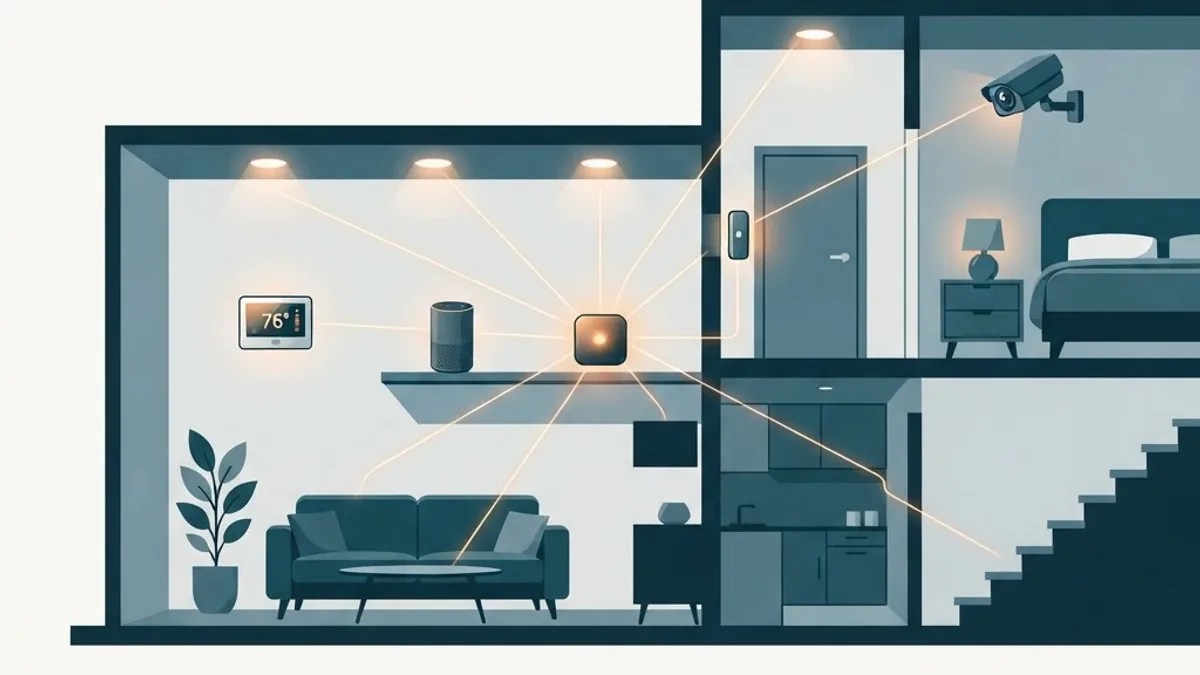
A grounded look at how smart home technology will change daily life, from energy bills and aging in place to security, privacy risks, and what to buy first.
Introduction
Most conversations about smart homes still focus on the wrong thing. Voice-controlled lights and app-operated blinds make for good product demos, but they are not what will actually change how people live. The meaningful changes are quieter and considerably more consequential: a heat pump that shifts its run time to the cheapest three hours of the night, a bathroom sensor that recognizes a fall before anyone calls for help, a leak detector that saves a basement from twenty thousand dollars of water damage, and a home that gradually stops requiring conscious operation at all.
This article looks honestly at how smart home technology will change lives across the next decade — what is already working, what remains overpromised, where the real financial and health returns come from, and what the genuine costs and privacy tradeoffs are. If you are deciding whether any of this deserves your money, the distinction between novelty and infrastructure is the one that matters.
Table of Contents
- What a smart home actually is now
- Why 2026 is the turning point: Matter and local control
- Change one: energy costs and grid participation
- Change two: aging in place and independent living
- Change three: health monitoring without wearables
- Change four: safety, security, and damage prevention
- Change five: reclaimed time and reduced mental load
- Change six: accessibility and disability independence
- Change seven: property value and insurance
- The honest downsides: privacy, security, and lock-in
- What the next decade realistically brings
- How to start without wasting money
- Frequently Asked Questions
- Conclusion
What a smart home actually is now
A smart home is not a house full of app-controlled gadgets. That is a remote-controlled home, and it usually creates more work than it removes — nobody wants to open an app to turn on a lamp.
A genuine smart home has three characteristics:
- Sensing. It gathers information about occupancy, temperature, humidity, air quality, light levels, water presence, energy use, and door or window state.
- Automation logic. It acts on that information according to rules or learned patterns, without a human issuing a command.
- Coordination. Devices from different manufacturers act as one system rather than ten separate silos.
The third point is where smart homes failed for over a decade, and it is the reason so many early adopters ended up with drawers full of abandoned hubs.
Why 2026 is the turning point: Matter and local control
Two developments have changed the trajectory.
Matter and Thread. Matter is a cross-industry connectivity standard backed by Apple, Google, Amazon, Samsung, and hundreds of manufacturers, designed so devices work with any compatible ecosystem. Thread is the low-power mesh network many Matter devices use. Together they attack the fragmentation problem directly: a Matter-certified sensor should work with Apple Home, Google Home, Amazon Alexa, and Home Assistant simultaneously. Adoption has been slower and messier than the marketing implied, and support for niche device types is still incomplete, but the direction is now clear and irreversible.
Local processing. Early smart homes routed everything through distant servers, so an internet outage disabled your light switches and a discontinued cloud service turned hardware into landfill. Newer systems run automation logic on a local hub, and increasingly run voice recognition locally too. This matters enormously for reliability, latency, and privacy, and it is the single most important spec to check before buying anything.
Change one: energy costs and grid participation
This is where the clearest financial return lives, and it is growing rather than shrinking.
Smart thermostats and heat pumps. Learning thermostats reduce heating and cooling energy by roughly 8 to 15 percent in typical homes through occupancy-aware setbacks and weather-anticipating pre-conditioning. Because heating and cooling is usually the largest share of a home energy bill, this alone often pays for the device within two heating seasons.
Time-of-use arbitrage. Utilities increasingly charge dramatically different rates by hour. A smart home can run the dishwasher, charge the electric vehicle, heat water, and pre-cool the house during cheap hours, then coast through expensive peak periods. Households on time-of-use tariffs frequently cut electricity bills by 20 to 30 percent without changing behavior at all, purely through scheduling.
Home batteries and solar coordination. Battery systems paired with rooftop solar decide continuously whether to store, use, or export power. As electricity pricing becomes more dynamic, that decision has real money attached to it.
Virtual power plants. Utilities now pay households to let a coordinated system briefly reduce demand or discharge a battery during grid stress. Thousands of homes acting together replace a peaking power plant. This turns a home from a passive consumer into a paid grid participant — a genuinely new economic relationship between households and utilities.
Circuit-level monitoring. Smart panels reveal which appliances actually consume power. The results routinely surprise people: an aging refrigerator, a pool pump running 18 hours a day, or a dehumidifier fighting a ventilation problem often accounts for a shocking share of the bill.
Change two: aging in place and independent living
This is the change with the greatest human impact, and it is where the technology stops being a convenience and becomes genuinely important.
Assisted living and nursing care are extraordinarily expensive, and the overwhelming majority of older adults would prefer to stay in their own homes. Smart home systems extend that possibility by years, in several specific ways:
- Fall detection using radar or millimeter-wave sensors, which detect falls without cameras and therefore without the dignity problems of video monitoring in bathrooms and bedrooms.
- Activity pattern monitoring that notices meaningful deviations — someone not opening the refrigerator all day, or getting up eight times a night — and can alert family before a crisis rather than after one.
- Medication reminders tied to actual cabinet or pill dispenser sensors rather than trusting memory.
- Stove and water shutoffs that automatically cut power or supply when a burner runs unattended or a tap is left running.
- Automatic pathway lighting that gently illuminates the route to a bathroom at night, which measurably reduces nighttime falls.
- Voice control for lights, thermostats, doors, and calls, which removes the need to reach switches or walk across rooms.
The important design principle here is passive monitoring. Systems that require an older adult to wear a device, charge it nightly, or press a button during an emergency fail exactly when they are needed most. Ambient sensing works whether or not anyone remembers it exists.
Change three: health monitoring without wearables
Homes are becoming quiet diagnostic environments.
Air quality monitors track particulates, carbon dioxide, volatile organic compounds, and humidity, then trigger ventilation automatically. This has direct measurable effects on asthma symptoms, allergy severity, sleep quality, and cognitive performance — high indoor CO2 demonstrably impairs concentration, which matters in every home office.
Sleep sensing through under-mattress or contactless radar sensors tracks breathing patterns, movement, and heart rate without anything worn. Some systems flag potential sleep apnea patterns that would otherwise take years to be diagnosed.
Bathroom and kitchen sensing can infer hydration and eating regularity, which are early indicators of decline in older adults.
The realistic caveat is that most of these devices are consumer wellness products, not regulated medical devices. They are good at spotting trends and prompting a doctor's visit. They are not good at diagnosis, and any product claiming otherwise deserves scrutiny.
Change four: safety, security, and damage prevention
Water leak detection deserves the top spot here, because water is the most common and most expensive home insurance claim after weather. A cluster of inexpensive sensors under sinks, behind the washing machine, and near the water heater, paired with an automatic shutoff valve, prevents catastrophic damage. The math on this is uncontroversial.
Fire and carbon monoxide. Interconnected smart alarms announce which room the danger is in, alert phones when nobody is home, and can automatically shut down HVAC systems so smoke is not distributed through the whole house.
Security. Cameras and doorbells have shifted from recording evidence to preventing incidents, using on-device recognition to distinguish a delivery from a person loitering, so alerts mean something and are not ignored.
Freeze prevention. Temperature sensors in vulnerable spaces detect conditions that lead to burst pipes and trigger heating before the pipe fails rather than after.
Change five: reclaimed time and reduced mental load
The daily benefit most owners describe is not time saved but attention saved. A well-configured home eliminates a category of small recurring worries: whether the door is locked, whether the garage is open, whether the iron is on, whether the heating is running in an empty house.
These are individually trivial and collectively significant. Removing dozens of small daily verification tasks is a real quality-of-life improvement, and it is why people who live in properly automated homes rarely go back.
The corollary is that good automation is invisible. If you are interacting with your smart home frequently, it is configured badly.
Change six: accessibility and disability independence
For people with mobility, vision, hearing, or dexterity limitations, smart home technology is not a convenience layer — it is independence.
Voice control replaces physical switches. Automated doors, blinds, and locks remove tasks that require reach or grip strength. Visual alert systems convert doorbells and alarms into light flashes for deaf users. Voice interfaces read information aloud for blind users. Eye tracking and switch-based controls let people with severe motor impairments operate an entire home.
The result is that tasks that previously required a caregiver's presence can be done independently. That reallocates paid or family care hours toward things technology cannot do, which is both a financial and a dignity gain.
Change seven: property value and insurance
Smart home features increasingly influence transactions. Buyers now treat efficient heating systems, EV charging capacity, and integrated safety systems as expected rather than exotic, particularly in newer housing stock.
Insurers offer premium discounts for monitored water shutoffs, smoke detection, and security systems, because the actuarial case for prevention is strong. Some carriers now supply sensors directly, which tells you exactly how well the economics work for them.
The honest downsides: privacy, security, and lock-in
Any credible discussion has to sit with the problems rather than skip past them.
Surveillance by design. A sensor-rich home produces an extraordinarily detailed behavioral record: when you wake, sleep, leave, return, shower, eat, and who visits. That data has commercial value and legal exposure, and it has already been subpoenaed in criminal cases. Before buying, ask where data is processed, how long it is retained, whether it is sold or shared, and whether the device functions with cloud access disabled.
Security vulnerabilities. Cheap connected devices are notoriously poorly secured, and a compromised camera or hub is a foothold inside your network. Practical defenses are unglamorous but effective: buy from vendors with a track record of firmware updates, isolate devices on a separate network or VLAN, change default credentials, and enable multi-factor authentication on the accounts that control everything. These are the same principles behind professional cybersecurity practice, scaled down to a household.
Cloud dependency and abandonment. Companies discontinue services. Devices that require a vendor's servers can and do stop working entirely. Locally controlled equipment is the only real protection against buying a product with a hidden expiration date.
Ecosystem lock-in. Committing entirely to one platform makes switching costly. Matter reduces but does not eliminate this.
Complexity and household friction. A system only one person in the house understands is a liability. If a guest, a partner, or a babysitter cannot turn on a light, the design has failed. Every automation should have an obvious manual override — a physical switch that simply works.
What the next decade realistically brings
Setting aside marketing, the credible near-term trajectory looks like this:
Ambient intelligence replacing commands. Homes will infer intent from context — time, occupancy, weather, calendar, and learned routine — rather than waiting for instructions. Fewer apps, fewer voice commands, more anticipation.
Natural language configuration. Large language models are already making it possible to describe an automation in plain speech instead of building rule trees. This removes the largest adoption barrier, which was never cost — it was setup difficulty.
Predictive maintenance. Vibration and current monitoring on appliances and HVAC systems will forecast failures weeks ahead, turning emergency repairs into scheduled ones.
Whole-home energy autonomy. Solar, battery, heat pump, and EV managed as one optimizing system rather than four separate purchases.
Robotics beyond vacuums. Slow, incremental, and consistently over-hyped. Expect capable single-task machines rather than general household robots.
Regulatory pressure. Expect enforced security baselines, mandatory support lifespans, and stronger data rights, following the direction European and Californian regulators have already taken.
How to start without wasting money
A pragmatic sequence, ordered by return rather than excitement:
- Water leak sensors and an automatic shutoff valve. Cheap, boring, and the highest expected value item on the list.
- A smart thermostat. The clearest energy payback, especially with time-of-use pricing.
- Interconnected smoke and carbon monoxide alarms. Safety first, and inexpensive.
- A local-first hub if you plan more than a handful of devices. Choose it before accumulating hardware, not after.
- Motion-triggered lighting in hallways, stairs, and bathrooms. Low cost, immediately appreciated, and genuinely reduces falls.
- Contact sensors on exterior doors and windows.
- Cameras and doorbells only after deciding your privacy position deliberately.
Two rules worth following: prefer devices that work without internet access, and add automations one at a time so you can tell what actually improved your day. The same discipline applies to any technology rollout, whether it is a household or an organization running web applications and internal systems.
Frequently Asked Questions
Does smart home technology actually save money?
Yes, in specific categories. Thermostats, time-of-use load shifting, and leak prevention have clear positive returns. Smart speakers, connected coffee makers, and app-controlled blinds are conveniences with no financial payback. The savings come from energy management and damage prevention, not from novelty devices.
What happens to my smart home if the internet goes down?
It depends entirely on the products chosen. Cloud-dependent devices typically stop responding. Devices using local control through Matter, Thread, Zigbee, Z-Wave, or a local hub keep running automations normally. This is the most important question to ask before buying.
Is smart home technology safe for older adults living alone?
Passive systems are often excellent for this purpose — radar fall detection, activity monitoring, automatic stove shutoff, and night lighting all work without requiring the person to wear or operate anything. Systems that depend on remembering to charge or press a device are considerably less reliable in real emergencies.
How much does it cost to make a home genuinely smart?
A high-value starter set covering leak detection, a smart thermostat, connected alarms, and motion lighting typically runs a few hundred dollars. A comprehensive whole-home system with a hub, extensive sensors, smart panels, and battery storage runs into the thousands, with energy hardware dominating the cost.
Are smart home devices a privacy risk?
They can be. Cameras, microphones, and detailed occupancy data are sensitive by nature. Reduce exposure by favoring local processing, avoiding cameras in private areas, using radar sensors instead of video where possible, isolating devices on a separate network, and reading retention policies before purchase rather than after.
Will Matter fix smart home compatibility problems?
It substantially improves them for common device types like lights, plugs, locks, sensors, and thermostats. Coverage for cameras, robot vacuums, and specialized equipment remains uneven, and implementation quality varies by manufacturer. Check certification for the specific device rather than assuming.
Do smart home features increase resale value?
Efficiency and safety infrastructure — heat pumps, EV charging, solar, integrated alarms — tends to hold value. Consumer gadgets generally do not, since buyers assume they will replace them with their own preferred ecosystem.
Can renters use smart home technology?
Yes. Smart plugs, bulbs, portable sensors, thermostats that fit existing wiring, and removable leak detectors all work without permanent modification and move with you.
Conclusion
Smart home technology will change lives less through spectacle than through accumulation. The house will get cheaper to run because it schedules its own consumption around electricity prices. It will get safer because it catches leaks, fires, and falls in the minutes that matter. It will let people stay in their own homes years longer than they otherwise could. It will remove a hundred small daily worries you never consciously registered as work. And for people with disabilities, it will replace dependence with independence.
The path to those benefits is not buying more devices. It is buying the right few — locally controlled, from vendors that support their hardware, chosen for return rather than novelty — and letting them work without your involvement. Start with a water sensor and a thermostat, get the boring wins, and expand only where the value is obvious.
Building a product or service in the connected home space? A credible digital presence matters as much as the hardware — from website design and React JS web development for device dashboards to digital marketing that explains real benefits instead of hype.