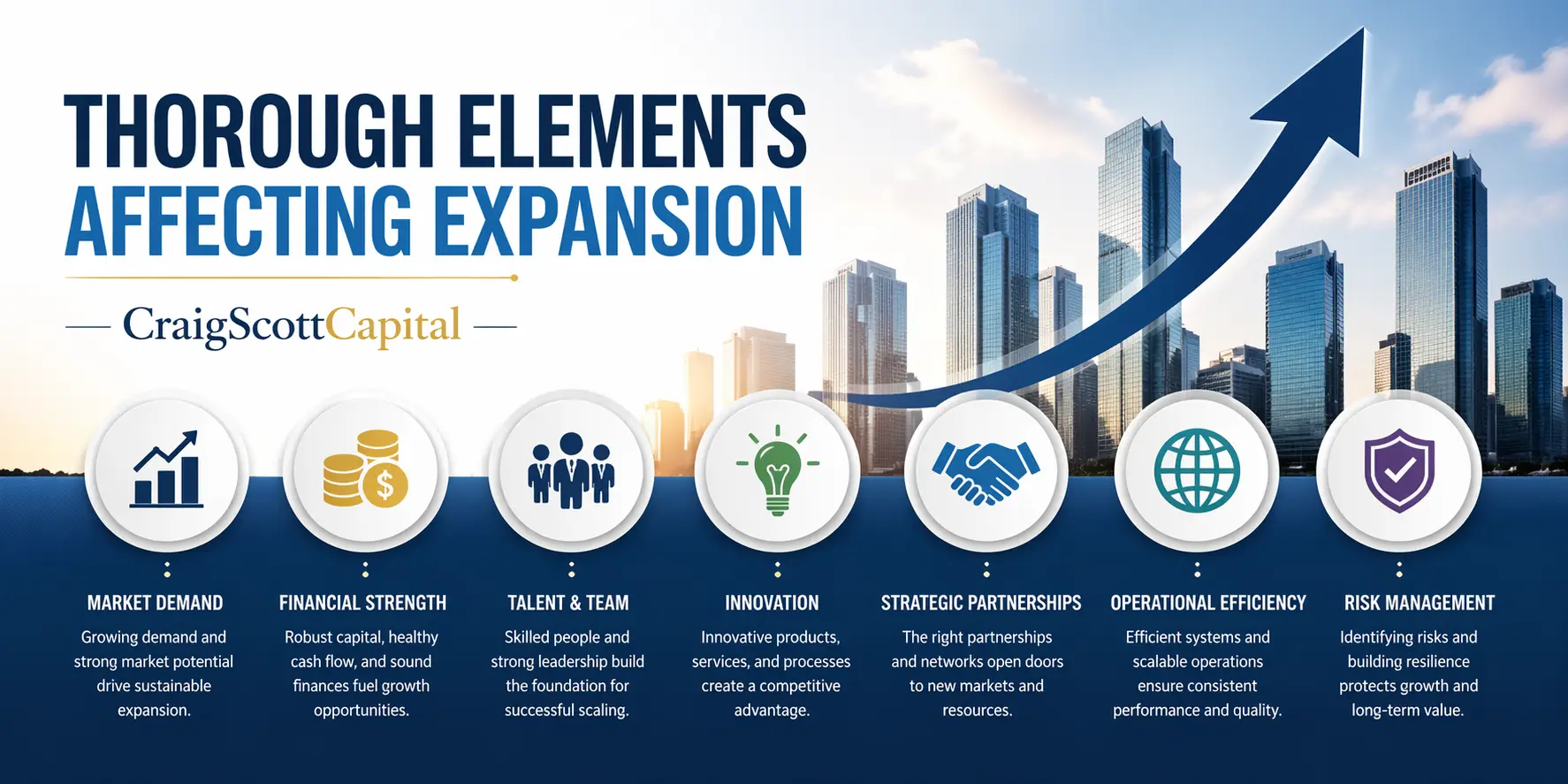
Explore the thorough elements affecting expansion CraigScottCapital: market trends, regulation, capital, operations, leadership, and growth strategies.
Thorough Elements Affecting Expansion CraigScottCapital: A Complete Analysis
Understanding the thorough elements affecting expansion CraigScottCapital requires taking a holistic view of the many factors that influence how a financial services firm grows, adapts, and competes. Expansion is never the result of a single decision — it's the product of market forces, regulation, capital availability, operational strength, leadership quality, and long-term strategic vision. Whether looking at CraigScottCapital specifically or similar firms in the wealth management and broker-dealer space, the same core factors tend to apply.
In this in-depth article, we'll examine the thorough elements affecting expansion, explore how each impacts a firm like CraigScottCapital, and offer frameworks you can use to evaluate or plan for growth in a financial services business.
Table of Contents
- A Brief Overview of CraigScottCapital
- Macroeconomic Forces
- Regulatory Landscape
- Capital and Funding
- Market Positioning
- Operational Infrastructure
- Technology and Innovation
- Leadership and Culture
- Client Relationships and Trust
- Risk Management
- Practical Framework for Expansion
- FAQs
- Conclusion
A Brief Overview of CraigScottCapital {#overview}
CraigScottCapital is a name associated with financial services, particularly in the broker-dealer and investment space. While firms in this sector can vary widely in size and strategy, they typically face a shared set of expansion challenges — including regulation, capital demands, and competitive pressure.
Common Traits of Firms in This Space
- Licensed and regulated by financial authorities
- Reliant on client trust and advisor relationships
- Sensitive to market volatility
- Subject to intense compliance oversight
Any analysis of expansion in such firms must account for all these complexities.
Macroeconomic Forces {#macro}
Macroeconomic conditions play a massive role in expansion decisions.
Key Macroeconomic Factors
- Interest rates – Influence borrowing, investment, and client activity.
- Inflation – Affects operational costs and client savings behavior.
- GDP growth – Drives overall financial activity.
- Market volatility – Impacts trading volumes and revenue.
- Unemployment trends – Shape household wealth and investment capacity.
Why This Matters
A firm attempting to expand during a recession faces very different dynamics than one expanding during a bull market. Strategic timing matters.
Regulatory Landscape {#regulatory}
Financial services firms operate in one of the most regulated industries in the world.
Key Regulatory Influences
- SEC and FINRA oversight (in the U.S.)
- State-level licensing requirements
- Anti-money laundering (AML) rules
- Know Your Customer (KYC) obligations
- Data privacy regulations
How Regulation Affects Expansion
- Expanding into new states or countries requires new licenses.
- Compliance costs grow with size.
- Non-compliance can halt expansion entirely.
- Regulatory changes can redefine business models overnight.
Capital and Funding {#capital}
Capital is the lifeblood of expansion.
Sources of Capital
- Retained earnings
- Bank financing
- Private equity investment
- Strategic partnerships
- Parent-company support
Capital Considerations
- Cost of capital affects profitability.
- Debt versus equity decisions shape long-term structure.
- Liquidity buffers are essential for regulated firms.
- Reserve requirements may mandate minimum capital levels.
Without adequate capital, even well-planned expansion can stall.
Market Positioning {#market-positioning}
A firm's ability to expand depends heavily on how it's perceived in the marketplace.
Positioning Elements
- Brand recognition
- Target client segments
- Product differentiation
- Pricing strategy
- Competitive advantages
Common Strategic Positions
- Boutique advisor for high-net-worth clients
- Broad-based broker-dealer for retail investors
- Specialized firm focusing on niche sectors
- Technology-driven online platform
Each position has its own expansion path and challenges.
Operational Infrastructure {#operations}
Operations are the engine beneath the surface of any expansion.
Key Operational Factors
- Back-office systems (clearing, settlement, reporting)
- Compliance and legal teams
- Human resources and advisor onboarding
- Office infrastructure and technology
- Vendor and outsourcing relationships
Scalability
Firms that invest in scalable infrastructure can expand more smoothly. Those with outdated systems often hit ceilings as they grow.
Technology and Innovation {#technology}
Technology has transformed financial services, and expansion today depends on it.
Technology-Driven Expansion Elements
- CRM and client portals
- Automated compliance monitoring
- AI-driven analytics
- Digital advisor platforms
- Cybersecurity infrastructure
Innovation as a Growth Lever
Firms that embrace technology can:
- Serve more clients with fewer resources
- Offer superior user experiences
- Identify new market opportunities faster
- Reduce operational risks
Leadership and Culture {#leadership}
Strong leadership is one of the most reliable predictors of sustainable expansion.
Leadership Qualities That Matter
- Strategic clarity
- Ethical decision-making
- Ability to attract talent
- Adaptability to change
- Strong communication
Cultural Elements
- Client-first mentality
- Compliance orientation
- Collaborative decision-making
- Innovation-friendly environment
A toxic or drifting culture can derail expansion even when markets are favorable.
Client Relationships and Trust {#clients}
In financial services, trust is the most valuable asset.
Client-Centric Expansion Factors
- Retention rates – Stable clients fund growth.
- Referral networks – Trust spreads organically.
- Advisor-client loyalty – Drives long-term AUM.
- Brand credibility – Impacts new client acquisition.
Building Trust at Scale
- Transparent fee structures
- Clear performance reporting
- Responsive customer service
- Consistent ethical behavior
Risk Management {#risk-management}
Expansion without risk management is a recipe for failure.
Key Risk Areas
- Market risk (volatile investments)
- Operational risk (systems, processes)
- Compliance risk (regulatory violations)
- Reputational risk (media, client trust)
- Cybersecurity risk
Risk Management Practices
- Structured compliance programs
- Internal audits
- Stress testing for financial stability
- Strong cybersecurity protocols
- Clear incident response plans
Practical Framework for Expansion {#framework}
Here is a simple framework you can apply when evaluating expansion for a firm like CraigScottCapital.
Step 1: Assess the Environment
- Analyze macro conditions
- Review regulatory changes
- Study competitive landscape
Step 2: Evaluate Internal Capabilities
- Audit operations and technology
- Review leadership depth
- Assess capital strength
Step 3: Define Expansion Goals
- New geographies?
- New client segments?
- New product lines?
- Acquisitions or organic growth?
Step 4: Build a Roadmap
- Set milestones
- Define KPIs
- Allocate resources
- Identify risks and mitigations
Step 5: Monitor and Adjust
- Track progress quarterly
- Listen to client and advisor feedback
- Remain flexible as conditions change
FAQs
1. What is the single most important factor affecting expansion?
There isn't a single factor — but strong leadership and adequate capital are consistently among the most important.
2. Can regulation really block expansion?
Yes. Licensing requirements, compliance obligations, and regulatory changes can significantly slow or prevent expansion.
3. How does technology drive financial services growth?
It enables scalability, efficiency, and better customer experiences, making growth more sustainable.
4. Why does culture matter for financial firms?
Culture shapes ethics, decision-making, and advisor retention — all essential for long-term success.
5. How can smaller firms compete with larger ones during expansion?
By focusing on niche markets, building strong relationships, and leveraging technology effectively.
Conclusion
The thorough elements affecting expansion CraigScottCapital — and firms like it — are deeply interconnected. Macroeconomic forces, regulation, capital, operations, technology, leadership, client trust, and risk management all play vital roles. A sustainable expansion strategy doesn't focus on just one of these factors; it addresses them holistically. By understanding and continuously monitoring these elements, financial services firms can pursue growth that is not only ambitious but also resilient, responsible, and built to last.