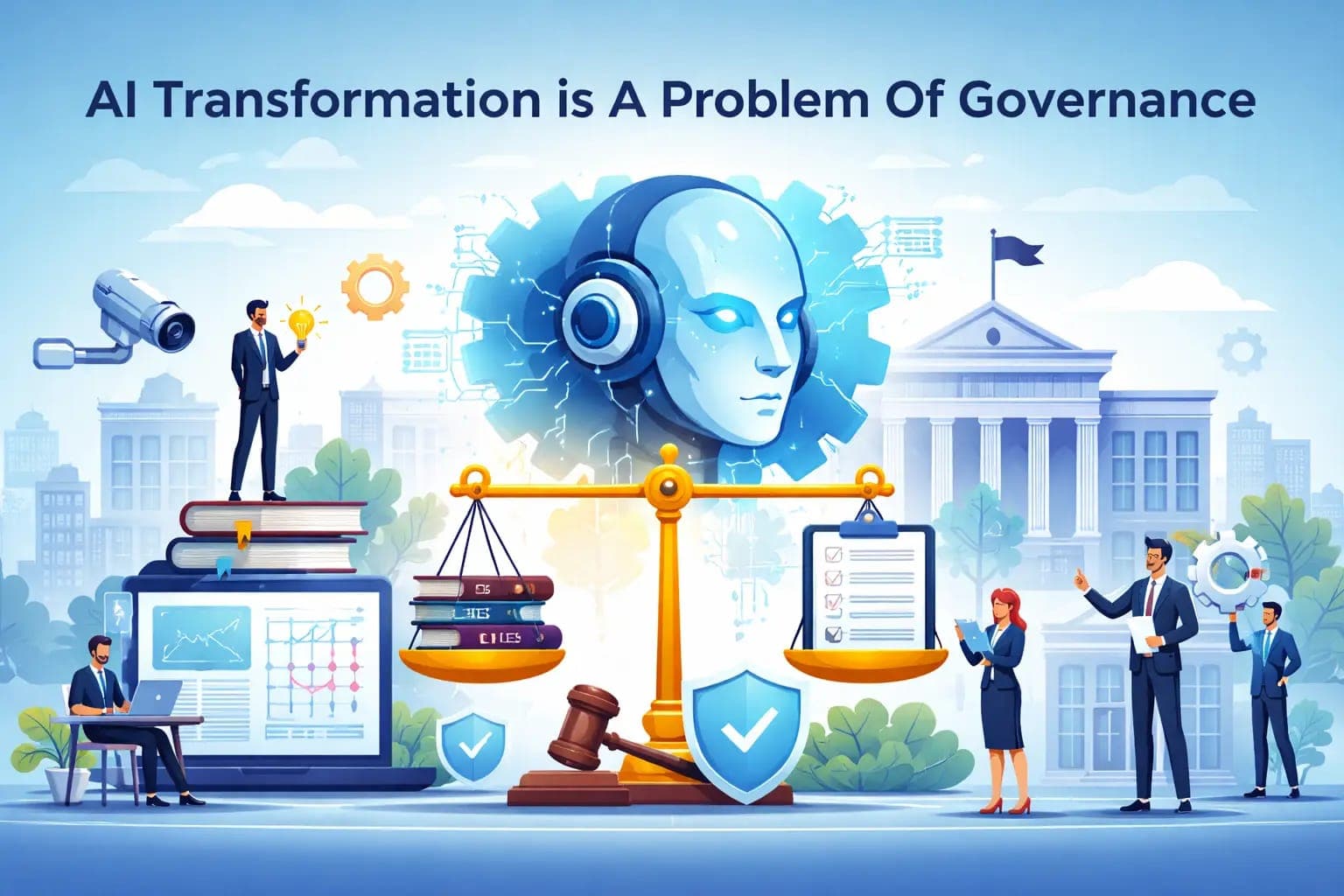
AI transformation is not just a tech challenge but a governance issue. Learn how leadership, policies, and accountability drive successful AI adoption.
Introduction
Artificial Intelligence (AI) is often portrayed as a purely technological revolutionone driven by algorithms, data, and computational power. Organizations rush to adopt machine learning tools, automate workflows, and integrate AI into products, believing that success lies in acquiring the right technology stack. However, this perspective misses a critical truth: AI transformation is fundamentally a problem of governance, not just technology.
Governance determines how decisions are made, who is accountable, how risks are managed, and how value is created and distributed. Without strong governance, even the most advanced AI systems fail to deliver meaningful results. In contrast, organizations with effective governance frameworks can unlock AI’s full potential, even with modest technical capabilities.
In this article, we will explore why AI transformation is primarily a governance challenge, the key components of AI governance, common pitfalls, and practical strategies to ensure success.
Understanding AI Transformation
What is AI Transformation?
AI transformation refers to the integration of artificial intelligence into the core operations, strategies, and culture of an organization. It goes beyond implementing toolsit reshapes how decisions are made and how value is delivered.
Key Elements of AI Transformation
- Data-driven decision-making
- Automation of processes
- Predictive and prescriptive analytics
- Organizational change and cultural shift
- Continuous learning systems
While technology enables these elements, governance ensures they are aligned with business goals and ethical standards.
Why AI Transformation is a Governance Problem
1. Decision-Making Authority
AI introduces new decision-making paradigms. Machines can now make or influence decisions that were traditionally human-driven. This raises questions such as:
- Who is responsible for AI-driven decisions?
- How are decisions audited?
- What happens when AI makes mistakes?
Without governance, these questions remain unanswered, leading to confusion and risk.
2. Accountability and Ownership
One of the biggest challenges in AI adoption is unclear ownership. Consider the following:
- Data teams build models
- IT teams deploy them
- Business units use them
Who is accountable if something goes wrong?
Effective governance establishes clear roles and responsibilities, ensuring accountability across the organization.
3. Ethical and Regulatory Concerns
AI systems can introduce bias, privacy issues, and unintended consequences. Governance frameworks are essential to:
- Ensure fairness and transparency
- Comply with regulations
- Protect user data
- Maintain public trust
4. Strategic Alignment
AI initiatives often fail because they are not aligned with business objectives. Governance ensures that:
- AI projects support organizational goals
- Resources are allocated effectively
- ROI is measurable and tracked
5. Risk Management
AI introduces new risks, including:
- Model bias
- Data breaches
- Operational failures
Governance provides the structure to identify, assess, and mitigate these risks proactively.
Key Components of AI Governance
1. Leadership and Vision
Strong leadership is the foundation of AI governance. Leaders must:
- Define a clear AI strategy
- Set ethical guidelines
- Foster a culture of accountability
Practical Tip:
Establish a dedicated AI governance board that includes stakeholders from technology, legal, and business teams.
2. Policies and Standards
Organizations need well-defined policies to guide AI development and deployment.
Examples:
- Data usage policies
- Model validation standards
- Ethical AI guidelines
3. Data Governance
Data is the backbone of AI. Poor data governance leads to poor AI outcomes.
Key Practices:
- Ensure data quality and accuracy
- Maintain data privacy and security
- Define data ownership
4. Model Governance
AI models must be monitored and managed throughout their lifecycle.
Includes:
- Model validation
- Performance monitoring
- Regular updates and retraining
5. Transparency and Explainability
Stakeholders must understand how AI systems make decisions.
Benefits:
- Builds trust
- Enables better decision-making
- Supports regulatory compliance
6. Compliance and Regulation
AI governance must align with legal requirements.
Areas to Consider:
- Data protection laws
- Industry-specific regulations
- Ethical standards
Common Challenges in AI Governance
1. Lack of Clear Ownership
Many organizations struggle with defining who owns AI initiatives. This leads to inefficiencies and accountability gaps.
2. Siloed Teams
AI projects often involve multiple departments, but lack of collaboration can hinder progress.
3. Rapid Technological Change
AI evolves quickly, making it difficult for governance frameworks to keep up.
4. Resistance to Change
Employees may resist AI adoption due to fear of job loss or lack of understanding.
5. Inadequate Skills
Governance requires expertise in both technology and policy, which many organizations lack.
Real-World Examples
Example 1: Financial Services
A bank implements AI for loan approvals but fails to establish governance. The model introduces bias, leading to regulatory penalties and reputational damage.
Lesson: Governance is essential for fairness and compliance.
Example 2: Healthcare
A hospital uses AI for diagnosis but lacks accountability structures. When errors occur, it is unclear who is responsible.
Lesson: Clear ownership is critical.
Example 3: Retail
A retailer successfully uses AI for demand forecasting with strong governance in place.
Key Factors:
- Clear strategy
- Cross-functional collaboration
- Continuous monitoring
Best Practices for Effective AI Governance
1. Establish a Governance Framework
Create a structured approach that includes:
- Policies
- Roles and responsibilities
- Decision-making processes
2. Align AI with Business Goals
Ensure every AI initiative supports strategic objectives.
3. Invest in Training
Educate employees about AI and governance principles.
4. Promote Collaboration
Encourage cross-functional teams to work together.
5. Monitor and Adapt
Continuously evaluate AI systems and update governance practices.
6. Focus on Ethics
Embed ethical considerations into every stage of AI development.
Practical Implementation Steps
Step 1: Assess Current State
- Evaluate existing AI capabilities
- Identify governance gaps
Step 2: Define Objectives
- Set clear goals for AI transformation
Step 3: Build Governance Structures
- Create committees and roles
Step 4: Develop Policies
- Establish guidelines for AI usage
Step 5: Implement Tools
- Use platforms for monitoring and compliance
Step 6: Review and Improve
- Regularly assess performance and risks
The Future of AI Governance
As AI continues to evolve, governance will become even more critical. Future trends include:
- Increased regulation
- Greater emphasis on ethical AI
- Advanced monitoring tools
- Global standards for AI governance
Organizations that prioritize governance today will be better positioned to adapt to these changes.
Conclusion
AI transformation is not just about adopting new technologiesit is about reshaping how organizations operate, make decisions, and create value. At its core, this transformation is a governance challenge.
Without strong governance, AI initiatives can lead to confusion, risk, and failure. With the right frameworks in place, organizations can harness AI responsibly, effectively, and sustainably.
The key takeaway is clear: technology enables AI, but governance determines its success.
By focusing on leadership, accountability, ethics, and strategic alignment, organizations can turn AI from a risky experiment into a powerful driver of growth and innovation.